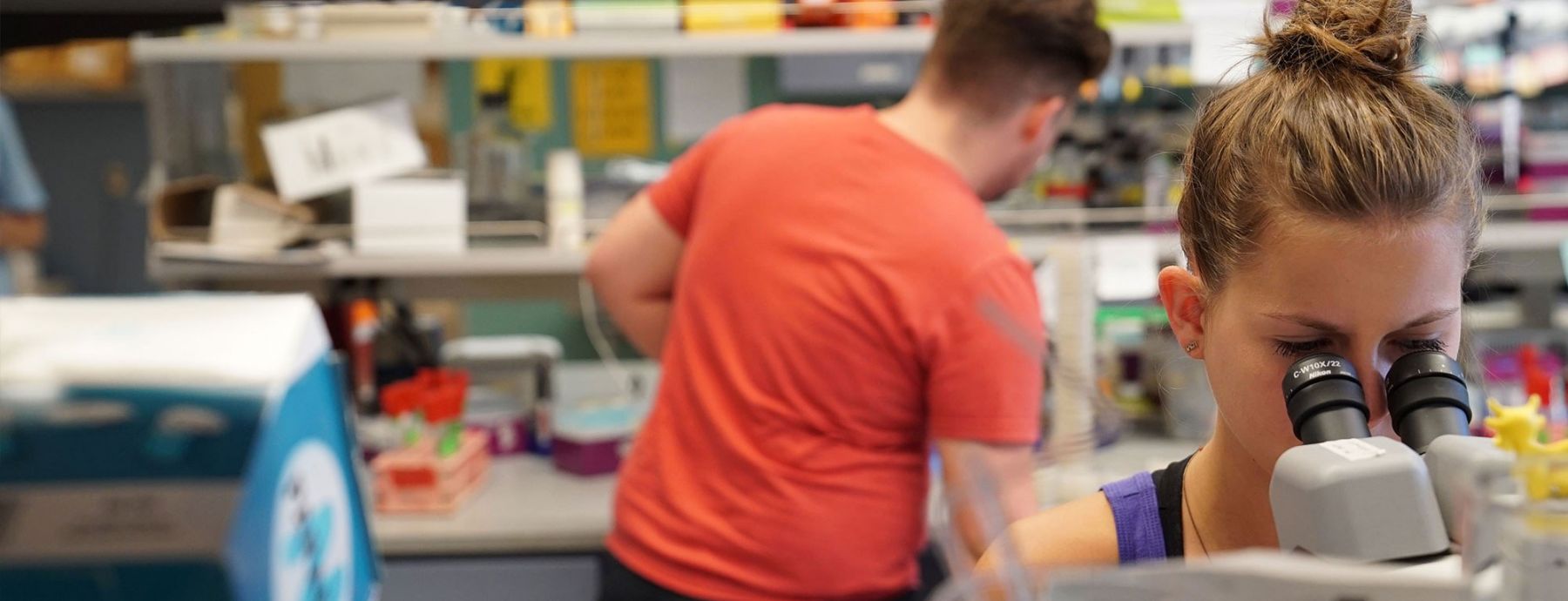
Person looking into a microscope.

Molecular, Cellular, and Integrative Biosciences

Gain an interdisciplinary perspective on cancer biology, cell and developmental biology, immunology and infectious disease, molecular and evolutionary genetics, molecular medicine, molecular toxicology, and neurobiology

The Molecular, Cellular, and Integrative Biosciences (MCIBS) Graduate Program is composed of more than 120 faculty members from six colleges and 15 basic science departments across the University Park campus. The program provides rigorous and in-depth training across a wide range of fields in the biological sciences. Students and faculty members work alongside each other to understand normal and disease processes at the molecular, cellular, and organismal levels.

Students entering the MCIBS program take a common set of courses during their first semester, while doing three research rotations in labs of their choice. At the end of the first semester, students choose a thesis lab and emphasis area. During the second semester, they take one more course together while also beginning to branch out into courses within their emphasis areas. Students also begin to shape their thesis projects during the second semester.

Courses help lay the foundation for subsequent research training. Students must produce a body of work in their thesis lab and demonstrate the ability to think critically and to design experiments. As students progress in their scientific training, they demonstrate these skills in two exams: the candidacy exam and comprehensive exam. The thesis and defense are the culmination of the Ph.D. training and showcase the work the student has accomplished.

  • Support is guaranteed, and additional internal and training grant awards are available
  • Over $500 million federal research dollars come to faculty at Penn State each year
  • MCIBS has over 120 faculty
  • Students have access to cutting edge tools and facilities to advance their research
News

Cell ‘invisibility cloaks’ could offer side-effect-free diabetes treatment

Outfitting cells in “invisibility cloaks” may offer an easier, less damaging treatment pathway for people with diabetes undergoing cell therapy, according to researchers at Penn State.

Andrew Patterson named H. Thomas and Dorothy Willits Hallowell Chair

Andrew Patterson has been named the H. Thomas and Dorothy Willits Hallowell Chair in Agricultural Sciences at Penn State. The professorship, which is named for H. Thomas Hollowell and his wife Dorothy Willits Hallowell, is granted to distinguished University faculty members to help enhance Penn State's commitment to the commonwealth by supporting the faculty member’s contributions to education, research and public service.

How does a deadly chicken virus escape vaccines designed to slow it?

A new genome-wide study of the virus that causes Marek’s disease in chickens has identified 10 regions in the virus genome that are associated with an increase in virulence. The study could inform the development of next-generation vaccines that are more effective at preventing future breakthroughs.

Chemical engineering professor honored for work on plant-based tissue scaffolds

Amir Sheikhi, the Dorothy Foehr Huck and J. Lloyd Huck Early Career Chair in Biomaterials and Regenerative Engineering and associate professor of chemical engineering at Penn State, recently received the 2025 Early Career Investigator Award from the journal BioResources. The award recognized a paper published by Sheikhi and his research team in 2026, titled “All-Cellulose Cryogels with Tunable Extracellular Matrix-MimeticArchitecture.”