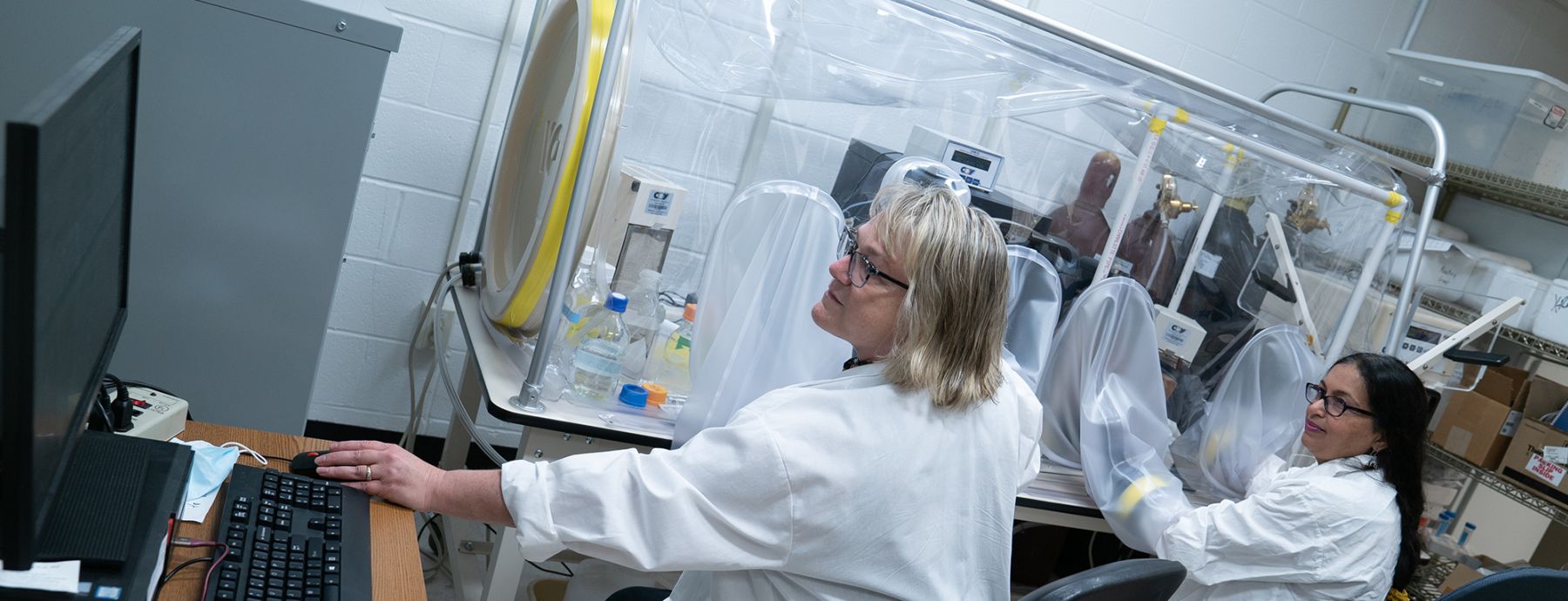
Automated Calorimetry Facility hero image

Biomolecular Interactions Facility

Analyzing the binding and folding of biological macromolecules using high-throughput instruments

The Biomolecular Interactions Core Facility provides the necessary infrastructure and support for individual investigators to undertake studies of macromolecule binding and folding, as well as protein and lipid quantification. Our calorimetry instruments are fully automated and require the least amount of sample of any commercially available instruments. Specifically, we provide instrumentation and collaborative assistance for:

  • Isothermal titration calorimetry (ITC)for studying ligand-macromolecule binding
  • Differential scanning calorimetry (DSC)for investigating stability and folding thermodynamics
  • Multiwavelength Analytical Ultracentrifuge (AUC) for determining the hydrodynamic shape, size, molar mass and binding thermodynamics of any macromolecule and its complexes
  • Circular Dichroism Spectrometer (CD) to determine aspects of protein secondary and tertiary structure
  • Lumicks C-Trap a single-molecule force microscope with two optical tweezers correlated with confocal-fluorescence and label-free microscopy

Our experienced staff is available to assist with project development and research.
News

Protein regulator of sugars and fats may work with an unexpected parter — itself

Penn State scientists characterize structure and function of protein implicated in liver disease working with another copy of itself, rather than its usual partner, to turn genes on and off

Borrowing from biology to power next-gen data storage

DNA, the genetic blueprints in every living organism, is nature’s most efficient storage mechanism, capable of storing about 215 million gigabytes of data per gram. That storage capacity, if applied to electronics, could enable significantly more efficient data centers, speedier data processing and the ability to process far more complicated data. The trick to making this technological leap is getting DNA, a biological material, to work with electronics. A team led by Penn State researchers has figured out how to bridge the wide compatibility gap.

Flipping and reversing mini-proteins could improve disease treatment

For the microbe that gives rise to tuberculosis, a team of researchers from Penn State and The University of Minnesota Medical School found that a potential solution may be chemically changing the structure of a naturally occurring peptide — a building block of proteins — to make it a more stable and effective antimicrobial agent, while reducing potential toxicity to human cells.

Modern methods in biological research course to be offered in spring 2026

Huck Institutes of the Life Sciences core facilities are offering a new course for spring 2026, Modern Methods in Biological Research, for upper-level undergraduate students and graduate students studying in the life sciences.