News

César de la Fuente, pioneer in artificial intelligence and bioengineering, will speak at Penn State on Dec. 5. Credit: César de la Fuente. All Rights Reserved.

World leader in AI and antibiotic discovery to deliver lecture at Penn State

César de la Fuente, Presidential Associate Professor at University of Pennsylvania and pioneer in AI-assisted antibiotic development, will visit Penn State on Dec. 5.

Leonid Berlyand and his research group apply mathematical principles to better understand and improve deep learning artificial intelligence.  Credit: Michelle Bixby / Penn State. Creative Commons

Q&A: Can mathematics reveal the depth of deep learning AI?

In the following Q&A, Penn State Professor of Mathematics Leonid Berlyand and graduate student Oleksii Krupchytskyi spoke about how they are applying mathematical principles to elucidate the black box nature of deep learning.

A team of researchers from Penn State and the University of Illinois Chicago has been awarded a grant from the U.S. National Science Foundation to employ biomedical research, clinical data, advanced artificial intelligence and mathematical modeling methods to ultimately support personalized medicine for people with Alzheimer’s disease. The team at Penn State includes Wenrui Hao, professor of mathematics and director of the Center for Mathematical Biology; Rui Zhang, assistant professor of computer science and engineering; and Wenpeng Yin, assistant professor of computer science and engineering. Credit: Penn State. Creative Commons

Can digital replicas of patients help personalize Alzheimer’s treatment?

New NSF grant supports project to build 'digital twin' replicas of patients using clinical data to study disease progression and treatment options.

Researchers typically have to watch recordings of children in eating studies, like the one this child and research assistant are participating in, to count and time each bite.  Credit: Provided by Kathleen Keller. All Rights Reserved.

Counting bites with AI might one day help prevent childhood obesity

An interdisciplinary team at Penn State published a pilot study demonstrating the potential of using AI to streamline research on obesity risk in children.

The Huck Institute of the Life Sciences at Penn State University Park. Credit: Patrick Mansell / Penn State. Creative Commons

Huck Institutes of the Life Sciences names 2025-26 seed grant recipients

The Huck Institutes of the Life Sciences at Penn State has selected eight research teams that span 12 departments across six colleges to receive 2025-26 seed grant funding.

A new study led by Penn State researchers shows for the first time how sound waves could function as a means of controlling micro-sized robots. Credit: Igor Aronson / Penn State. Creative Commons

Tiny robots use sound to self-organize into intelligent groups

Microrobots modeled in simulations communicate via sound to form ‘acoustic swarms’ and move collectively.

In front of the main World Health Organization (WHO) building in Geneva, Switzerland, a statue commemorates the 30th anniversary of the eradication of smallpox. Now, researchers at Penn State and the WHO have developed a new method to estimate and predict regional measles vaccination coverage levels even when accurate or timely survey data on vaccination is not available. The new method can be used to guide better targeted vaccination interventions to potentially make measles the next human virus eradicated since smallpox. Credit: © WHO / Christopher Black . All Rights Reserved.

Predicting vaccination levels without accurate or timely vaccination data

Researchers at Penn State and the World Health Organization develop method to predict measles vaccination levels using routinely collected clinical data on suspected measles cases.

Using AI-driven pattern recognition, TalkingSick analyzes short voice recordings to detect deviations from a user’s healthy voice baseline. These deviations could signal potential respiratory illnesses before physical symptoms appear. The startup team participated in the NSF I-Corps National Teams program, which they completed in June. The program requires teams to complete at least 100 customer interviews in just seven weeks. Credit: Provided by TalkingSick. All Rights Reserved.

Startup works to detect respiratory illnesses through vocal patterns

TalkingSick startup launches through Invent Penn State NSF I-Corps programming.

Credit: Sharon Siegfried / Penn State. Creative Commons

Grant to help establish AI, health research lab at Harrisburg

A pair of Penn State Harrisburg faculty have been awarded funding to establish a research lab focused on using artificial intelligence (AI) and machine learning (ML) to improve health care access and outcomes.

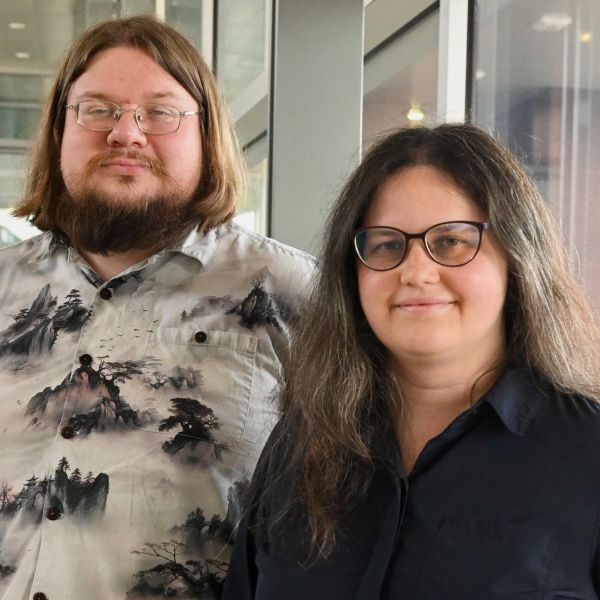
Anton Bankevich and Yana Safonova, two assistant professors of computer science at Penn State, helped develop a specialized algorithm to analyze and verify complex genome sequences. Credit: Caleb Craig/Penn State. All Rights Reserved.

Understanding us: Researchers apply algorithm to decode complex genome sequences

Two assistant professors of computer science at Penn State helped develop a specialized algorithm to analyze and verify complex genome sequences.